
middle aged witches
a recommendations post, with genre trouble and oracles
tl; dr I’m reading Deborah Harkness’s Black Bird Oracle, which is what I need right now.
When I was first coming into my folk, I listened to the Discovery of Witches trilogy by Deborah Harkness, and it gave me all of the “she’s me” feelings. The protagonist of the trilogy is named Diana! After an early adulthood of rule following as an academic historian, she finds herself exploring magic! She discovers new insights about the past through her embodied experience that would have been impossible through academic research! Yeah ok it was also a romance fantasy involving an of-course self righteously possessive vampire, but I was mostly able to endure (and even enjoy) that for the pleasure of reading Harkness, herself an academic, exploring important historical concepts through the tools of magic, fantasy, and fiction. Diana came into her power, and it helped me understand mine.
I’m a genre fic reader. I don’t find the literary expectation of “plausibility” to be particularly interesting or useful. I enjoy the way sci-fi functions as longform thought experiments. It helps us to see through things our society takes for granted, to play with not just the specifics of character, setting, or conflict, but about the basic assumptions and parameters of society. I’m with Sister Suzette Haden Elgin (her cake will come next year) who argued that feminists need sci-fi, because we need stories where we get to define all the terms (and create the language).
I like how mysteries and gothic novels are ferociously attentive to the specifics of place - letting the setting become not just a character but also full of volition, with desires and resentments and long buried secrets.
I like how historical fiction models the historical understanding practices of perspective taking, teaching us to envision layers of time in a place. I like how it makes it easy to understand a basic truth of historical storytelling — that the past is on some level always unknowable, that our stories and interpretations require leaps of imagination as well as careful sleuthing.
Amitav Ghosh, in his book The Great Derangement, argues that there’s another reason to value genre fiction’s willingnes to exceed or reject “believability.” Climate change. Our world no longer follows old parameters, and we can’t rely on our existing assumptions. It’s the real world that is uncanny, animated by unknowns. Genre fiction has been more able to incorporate this actual reality than “literature” has.
There are other epistemological (how we know what we know, what and how we understand to be true) dynamics besides climate change, that genre fictions can handle more deftly than other modes. In grad school I was obsessed with Carrie Lambert-Beatty’s concept of “parafiction,” which she coined in order to talk about a proliferation in the aughts of artworks that created fake characters and plotlines with the visual language of recognizable nonfiction settings. Maybe this was like Stephen Colbert’s famous “truthiness,” but there was and is also a sense that we need parafiction to help us ask questions about how and why we create narratives and assumptions. Removing the requirement for “facts” allowed artists and the audience to wonder, “how do we come to believe what we do about the way the world works?” But, some people, perhaps less philosophically inclined, might consider this kind of thing a prank or a hoax. They might feel made a fool of, like it was a way to show that they didn’t know enough to know it was fake, like an elaborate, artistic trolling.
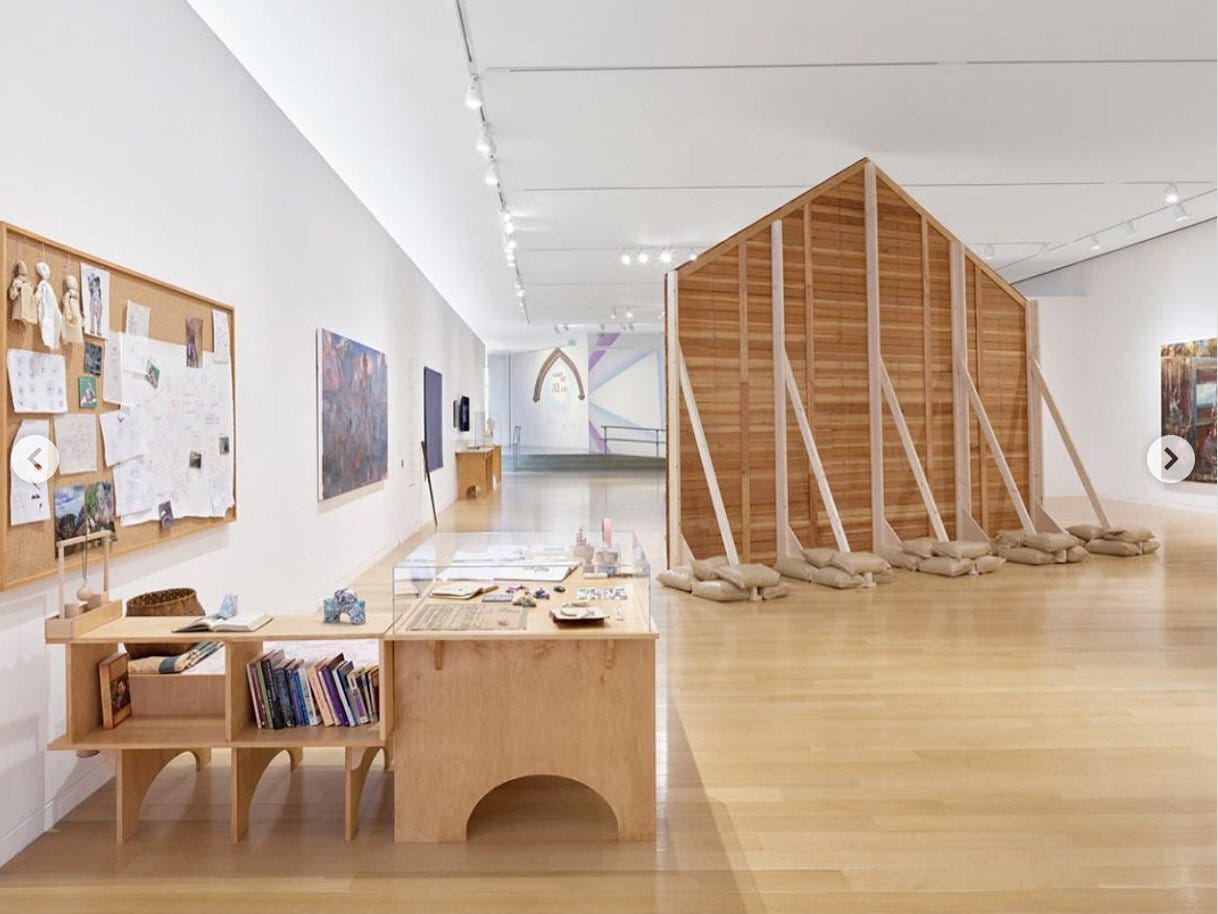
I addressed this question when I was working on “Annsisters: the Lost Library of Latona.” Tantalized by the what-ifs of my historical research, I had begun to create a fictionalized mythology, extrapolated from provable Classical characters and my 19th century research, because it felt like the only way to express what felt true to me about my experience in the archive.
So what I mean is, I know why Harkness did what she did. Another excellent writer on this subject is Katherine Howe, who had to leave her PhD in American Studies to write about witchcraft, and models some of the best historical site visualization I’ve ever read. History as a field is scant on methodology; the archive-witches in these novels give us a better picture of it than we might imagine, if we only see the surface of glowing manuscripts and sexy vampires.
Back to the recommendation then, because I’m not exactly recommending Physick Book of Deliverance Dane (excellent) or A Discovery of Witches. Instead, I’m recommending Black Bird Oracle, in which witch Diana is now over 40, married (to the vampire), and mom to two seven year olds.
There’s something that happens when a romance/fantasy character becomes middle aged and monogamous. It’s one of the things I love about the Outlander series too. There’s still love and some sexiness — and a hell of a lot less bitching about husbands than in the middle aged monogamy I am generally surrounded by, which is refreshing and a nice reminder that it doesn’t have to be this way — but the tension, that thing that novelists are supposed to use to ricochet their stories forward, it has to come from somewhere else. Because ever after has already happened.
Where, then?!
Well, as for all of us: from inside. Diana Bishop, lovingly prodded by some attentive, no-nonsense elders, has to figure out what she wants. Not for her love, or for her career, or for her kids. But for her self. It’s like a freaking book length meditation on the Mary Oliver poem “The Journey,”
though the whole house
began to tremble
and you felt the old tug
at your ankles.
‘Mend my life!’
each voice cried.
But you didn’t stop….as you strode deeper and deeper
into the world,
determined to do
the only thing you could do–
determined to save
the only life you could save.
And what do you have to do in order to find out what you want? First of all, you need quiet. “You can’t think with all of that noise around you!” says Aunt Gwynnie. You need to step away from your regular life, from those tugs at your ankles. Then, in that quiet, you have to learn to accept ambiguity and the unknown, the fact that there is no clear way forward. You have to figure out how to listen and be of service, rather than of servitude. You have to listen, and just — take a step.
Black Bird Oracle has as its center a set of oracle cards with no guide book and no traditional imagery. Diana has to learn to read them, just as once someone made them: by finding what the images mean to her, and listening to the world. If the first three novels feel like metaphors for research, this novel feels like a metaphor for finding out how to live, cloaked in the velvet wings of an easy read, set in one of my favorite places in the world, the Great Marsh, off of Ipswich. There are embroidered clamdiggers and Sox hats and lobstahs. I miss it already.
*
If you’re interested in these kinds of ideas, intellectually, from a research or a literary craft perspective, or for yourself as a human living a life, I recommend If Women Rose Rooted, by Sharon Blackie. She uses her own personal story interwoven with the traditional folklore and mythology of the British Isles (her expertise) in order to develop a theory of a “heroine’s journey” that differs from the “hero’s journey” in that it is rooted in place and community, and also does not focus on the heroics of youth but instead on the trajectory of a woman’s whole life story.
There is also the “Carrier Bag Theory of Fiction” by Ursula K. Le Guin. In this essay she argues that a plot doesn’t need tension, conflict, or a linear progression in order to function, and in fact that these ideas are male-normative. Instead, she wonders, can a story be a place for rest and gathering, like a woman’s basket, rather than a spear, which a man carries a long way to slay a beast, before he returns home? This is another way of thinking about feminism in sci-fi. Those later Outlander books are a great example of this, I think: the lengthy descriptions of domestic processes like malting grain for beer, processing fruit for winter storage, and doing laundry are, for me, the most riveting sections of the books.
*
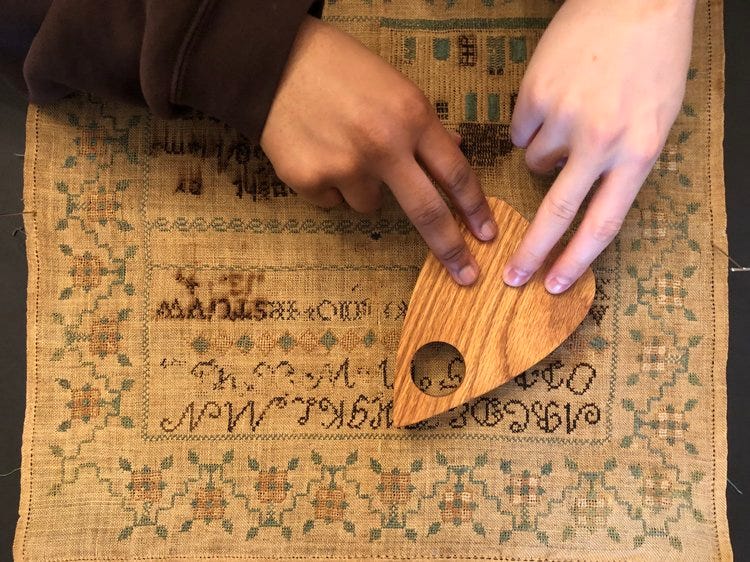
So, are we getting some oracle cards?! Are we sitting with ourselves in the quiet dark? Maybe read Alexandra Cain, and she will help us find the Middle Path for our hearts and our craft. Or the Rebis, to help us interpret the cards. Or maybe we can study Southern Style divination with Selah Saterstrom, and learn to let the cards pop. Or Lisa Fazio will help us interpret our dreams. Maybe we can put the planchette on an artifact like I did at Brown, and see what comes from between the stitches. But the real resource is inside ourselves, right? We can make our own oracles, using the found objects from our personal and family mythologies, a different way of working with an archive. We can work with the land and colors around us, with the mysteries of our own minds. I can’t wait to see what we find.
I’m reading The Black Bird Oracle right now too! This is a wonderful companion piece.